Tuesday, 28 August 2012

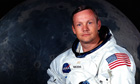
Death of Neil Armstrong


Neil Armstrong's death

prompts yearning for America's past glories


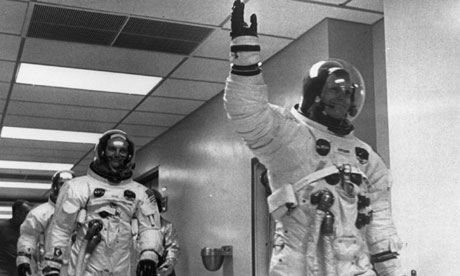
The death of Neil Armstrong, the first man to walk on the moon, has prompted a bout of soul-searching about America's national destiny as well as mourning for an icon of the 20th century.
As tributes continued to pour in on Sunday for the former astronaut who died aged 82 there were also expressions of regret that no human has been back to the moon since 1972, just three years after Armstrong set foot on it and gave his famous "giant leap for mankind" speech.
Elliot Pulham, chief executive of the Space Foundation, decried today's lack of backing for America's space agency Nasa, compared with the vast resources devoted to the moon landings programme in the 1960s.
"In this age of timid exploration goals and paltry Nasa budgets, Armstrong looms as a larger-than-life reminder of what our nation was once capable of," he said. Pulham said the real life drama of Armstrong's moon landing – watched by a fifth of the world's population – was unlikely to be repeated now except fictionally in a summer blockbuster.
He said: "In an age when Hollywood and professional sports manufacture so-called 'heroes', Armstrong exemplified the right stuff. He was the real deal."
Armstrong died on Saturday following heart problems that ensued after he underwent bypass surgery near his Ohio home earlier this month. His recovery had been thought to be going well, and his death came as a surprise to many.
A statement released by his family gave few details, but spoke of a "reluctant American hero" and said to those who might want to pay tribute to him: "Honour his example of service, accomplishment and modesty, and the next time you walk outside on a clear night and see the moon smiling down at you, think of Neil Armstrong and give him a wink."
Speaking from the White House, Barack Obama said the self-declared "nerdy" engineer was "among the greatest of American heroes – not just of his time, but of all time". He added: "And when Neil stepped foot on the surface of the moon for the first time, he delivered a moment of human achievement that will never be forgotten."
Armstrong's crew member on Apollo 11 and the second man to walk on the moon, Buzz Aldrin, said he was "deeply saddened" by the loss of his good friend and "space exploration companion" with whom he had hoped to mark the 50th anniversary of their mission in 2019.
"Whenever I look at the moon I am reminded of that precious moment, over four decades ago, when Neil and I stood on the desolate, barren, yet beautiful, Sea of Tranquillity," he said in a statement. "Looking back at our brilliant blue planet Earth suspended in the darkness of space, I realised that even though we were farther away from Earth than two humans had ever been, we were not alone.
"Virtually the entire world took that memorable journey with us. I know I am joined by many millions of others from around the world in mourning the passing of a true American hero and the best pilot I ever knew. My friend Neil took the small step but giant leap that changed the world and will forever be remembered as a historic moment in human history."
Across the US, there was a sense that he represented the achievement of a past age of American greatness. Many focused on how the bid for the moon had been begun by John F Kennedy who as president audaciously set the target of putting a man there in a 1961 speech.
Armstrong – a quiet man who shunned fame – seemed to symbolise that dream fulfilment of a national goal, rather than the current situation which has seen Nasa cancel or curtail numerous missions in the face of budget squeezes.
Former astronaut Eugene Cernan, the last man on the moon, said: "He [Kennedy] challenged us to do something people thought was impossible. What couldn't be done. Neil was the focal point of that … He was the epitome of doing something that people thought was impossible."
Others too mourned Armstrong by decrying the state of the US. "Today we cannot pass a budget through both houses of Congress in as much time as it took to send a man into orbit," wrote columnist Andrew Pasternak on the news and culture website Policymic. "The time it took to rebuild lower Manhattan after 9/11 … will be longer than it took to build an entire space program and send a man to the moon."
Of course, Nasa does have its modern triumphs. Its engineers have just achieved the remarkable feat of landing a nuclear-powered rover on Mars. The robotic geologist is designed to spend years on the Martian surface. Another Mars mission has also just been announced, this one involving a more simple lander designed to drill below the planet's surface.
But these endeavours do not even come close to matching the excitement of Armstrong's success: no doubt in part because of the human element.
Nasa administrator Charles Bolden seemed to hint at that in his statement of tribute. "As we enter this next era of space exploration, we do so standing on the shoulders of Neil Armstrong," he said.
Armstrong is believed to have shared the sense of scepticism and dismay at Nasa's diminished ambitions. Eric Berger, who runs the SciGuy science blog, revealed that earlier this month he had been forwarded an email that Armstrong and other space exploration veterans had been circulating. It expressed frustration at the current travails of Nasa and quoted Yogi Berra, an American baseball legend. According to Berger the quote read: "If you don't know where you are going, you might not get there."

Saturday, 25 August 2012

Harry potter spells

Harry Potter Spells
Disarming CharmExpelliarmus (takes the wand from the opposing person and brings the wand to you.) 
Confusion Charm (used for Boggarts)Riddikulus (In the 3rd book, The Prisoner of Azkaban, Remus Lupin brought the class to face a Boggart that lives in a closet. The Boggart would take form of what they most feared and they had to conquer that fear by thinking of something they didn't fear. Neville was scared of Snape, so the Boggart took Snape's form and then Neville thought of his Grandmother, something he did not fear and then said the charm. The Boggart got confused and then had Snape wearing his Grandmother's clothing. C'mon, don't tell me you don't remember that
Memory CharmObliviate (Takes away your memory. Gilderoy Lockhart used it in the 2nd book, Chamber of Secrets) 
Summoning CharmAccio (Mrs. Weasley wanted the candy from George's pocket, but he wouldn't give it to her. So, she used this charm to bring it out of his pocket to her. Useful, no?) 
Patronus CharmExpecto Patrono (Used to get rid of Dementors. You first have to think a very happy thought while saying it for it to work and to be effective.) 
Levitating CharmWingardium Leviosa (levitates things; make things rise) 
Tickling CharmRictusempra 
Dancing CharmTarantallegra (I highly doubt this is used to make someone a better dancer, but rather it's used just to make someone dance.) 
Fixing CharmReparo (fix something that's broken) 
Makes FlowersOrchideous (it makes the flowers come out from the tip of the wand) 
Conjures BirdsAvis (Mr. Ollivander used it and it first made a blast like a gun, but then number of small twittering birds flew out of the end of the wand) 
Ripping CharmDiffindo (to rip something like a bag) 
EnlargenEngorgio 
ReduceReducio (Makes something smaller. Like a counter thing for the Enlargen spell. 
Enlargen TeethDensaugeo (thanks goes to WufeiChangx822 for telling/correcting me!) 
FireIncendio (Lights a fire; to make a fire in the fireplace.) 
LightLumos (Appears on tip of wand. Think flashlight for wizards/witches.) 
Nox- used to extinguish the the light after, "Lumos." 
Open LocksAlohomora 
Conjure SnakeSerpensortia (makes a long black snake) 
Repel WaterImpervius (Used on Harry's glasses when he was playing Quidditch and it was raining) 
Create Bandages/SplintFerula (have to tap on the body part where you want the bandages/splints to be) 
See Invisible InkAparecium (Must tap parchment three times. Snape wanted to see what was on the Maurader's Map thinking it was all in invisible ink.) 
Move ObjectsMobiliarbus (moves an object from one place to another) 
Moving BodyMorbilicorpus (used when Snape was unconscious in Book 3. I'm unsure whether the person has to be conscious or not for the spell to work) 
Last Spell?Prior Incantato (If you want to know what the wands last spell was, you use this charm. Must have the tip of your wand touching the tip of the one being tested for the charm to work) 
Deletrius- When you're done seeing the spell that was used last, you use this charm to clear away the image. 
Make Your Voice LouderSonorus (heightens your voice tremendously so if your in a big Quidditch field, everyone can hear you) 
Quietus- opposite of the above. It makes your voice go back to your normal level. 
 
Curses:
The Three Forbidden Curses: (when used, you gain a lifetime sentence in Azkaban) The Imperius CurseImperio- Gives the caster full control over the person under the spell.
The Cruciatus CurseCrucio- It delivers a lot of pain to the person who is being casted under this spell. It's a form of torture. (It can drive you insane, like Neville's parents, if you are under it a lot.)
The Killing CurseAvada Kedavra- True to it's name; unblockable
The rest of the spells are not as severe as the Forbidden ones. 
Leg Locker CurseLocomotor Mortis (The person casted under the spell has his/her legs binded together by an invisible force. Think mermaid, but discount fins and breathing under water.) 
Full Body Bind CursePetrificus Totalus (your legs get stuck together, as well as your arms. Think worm.) 
FreezeStupefy (not freeze someone into ice, but make them stop moving. I was thinking of putting this under Charms, but since it hinders someone/thing, I put it under Curses instead) 
Ennervate- to un-freeze the person under the above spell 
Boils CurseFurnunculus (makes ugly boils form on the person's skin) 
Reducto CurseReducto (enables the caster to blast solid objects away with this curse) 
Impediment CurseImpedimenta (slows down the person/thing and used to abstract attackers)
Conjure the Dark MarkMorsmordre (makes the Dark Mark, a skull with a snake around it, appear in the sky. Used to gather Death Eaters, Voldemort's followers, and to let others know he was there.) 

Thursday, 16 August 2012

Lamborghini

Lamborghini
Automobili Lamborghini S.p.A., commonly referred to as Lamborghini, designs, engineers, manufactures and distributes luxury sports cars. Lamborghini's production facility and headquarters are located in Sant'Agata Bolognese, Italy. In 2011, Lamborghini's 831 employees produced 1,711 vehicles.


Manufacturing magnate Ferruccio Lamborghini founded Automobili Ferruccio Lamborghini S.p.A. in 1963 with the objective of producing a refined grand touring car to compete with offerings from established marques such as Ferrari. The company's first models were released in the mid-1960s and were noted for their refinement, power and comfort. Lamborghini gained wide acclaim in 1966 for the Miura sports coupĂ©, which established rear mid-engine, rear wheel drive as the standard layout for high-performance cars of the era.
Lamborhini grew rapidly during its first decade, but hard times befell the company when sales plunged in the wake of the 1973 worldwide financial downturn and the1973 oil crisis. Lamborghini's ownership changed three times after 1973, including a bankruptcy in 1978, before Chrysler Corporation took control of Lamborghini in 1987. Unable to operate Lamborghini profitably, Chrylser sold Lamborghini to Malaysian investment group Mycom Setdco and Indonesian group V'Power Corporation in 1994. Lamborghini's lack of success continued through the 1990s, until Mycom Setdco and V'Power sold Lamborghini to the AUDI AG subsidiary of VOLKSWAGEN AKTIENGESELLSCHAFT on July 27, 1998. Audi's ownership marked the beginning of a period of stability and increased productivity for Lamborghini. Sales increased nearly tenfold over the course of the 2000s, peaking with record sales in 2007 and 2008. The world financial crisis in the late 2000s negatively affected all luxury car makers worldwide, and caused Lamborghini's sales to drop nearly 50 percent.
Lamborghini's Sant'Agata Bolognese production facility produces V12 engines and finished automobiles. Lamborghini's current production vehicles are the V10-powered Gallardo and the V12-powered Aventador. Both production models are available in a variety of regular and limited-edition specifications.


Wednesday, 15 August 2012

Mahatma Gandhi

Mahatma Gandhi
BornOctober 2, 1869, Porbandar
AssassinatedJanuary 30, 1948, Birla House
SpouseKasturba Gandhi (m. 1883–1944)
ChildrenHarilal Gandhi, Devdas Gandhi,Ramdas Gandhi, Manilal Gandhi
EducationUniversity College London, University of London
Mohandas Karamchand Gandhi , commonly known as Mahatma Gandhi, was the preeminent leader of Indian nationalism in British-ruled India. Employing non-violent civil disobedience, Gandhi led India to independence and inspired movements for non-violence, civil rights and freedom across the world.
Son of a senior government official, Gandhi was born and raised in a Hindu Bania community in coastal Gujarat, and trained in law in London. Gandhi became famous by fighting for the civil rights of Muslim and Hindu Indians in South Africa, using the new techniques of non-violent civil disobedience that he developed. Returning to India in 1915, he set about organising peasants to protest excessive land-taxes. A lifelong opponent of "communalism" (i.e. basing politics on religion) he reached out widely to all religious groups. He became a leader of Muslims protesting the declining status of the Caliphate. Assuming leadership of the Indian National Congress in 1921, Gandhi led nationwide campaigns for easing poverty, expanding women's rights, building religious and ethnic amity, ending untouchability, increasing economic self-reliance, and above all for achieving Swaraj—the independence of India from British domination.
Gandhi led Indians in protesting the national salt tax with the 400 km (250 mi) Dandi Salt March in 1930, and later in demanding the British to immediately Quit India in 1942, during World War II. He was imprisoned for that and for numerous other political offenses over the years. Gandhi sought to practice non-violence and truth in all situations, and advocated that others do the same. He saw the villages as the core of the true India and promoted self sufficiency; he did not support the industrialization programs of his disciple Jawaharlal Nehru. He lived modestly in a self-sufficient residential community and wore the traditional Indian dhoti and shawl, woven with yarn he had hand spun on a charkha. His political enemy Winston Churchill ridiculed him as a "half-naked fakir. He was a dedicated vegetarian, and undertook long fasts as means of both self-purification and political mobilization.


In his last year, unhappy at the partition of India, Gandhi worked to stop the carnage between Muslims on the one hand and Hindus and Sikhs that raged in the border area between India and Pakistan. He was assassinated on 30 January 1948 by a Hindu nationalist who thought Gandhi was too sympathetic to India's Muslims. 30 January is observed as Martyrs' Day in India. The honorific Mahatma or "Great Soul", was applied to him by 1914. In India he was also called Bapu . He is known in India as the Father of the Nation; his birthday, 2 October, is commemorated there as Gandhi Jayanti, a national holiday, and world-wide as the International Day of Non-Violence. The title of 'Father of Nation' was not formally conferred by the Government on Gandhi. Gandhi's philosophy was not theoretical but one of pragmatism, that is, practicing his principles in real time. Asked to give a message to the people, he would respond, "My life is my message.


Independence Day

Happy Independence Day
The Independence Day of India, celebrated on 15 August, is a holiday commemorating India's independence from the British rule and its birth as a sovereign nation on 15 August 1947. India achieved independence following the Indian independence movement noted for largely peaceful nonviolent resistance and civil disobedience led by the Indian National Congress. The independence coincided with the partition of India wherein the British Indian Empire was divided along religious lines into two new states—Dominion of India (later Republic of India) and Dominion of Pakistan (later Islamic Republic of Pakistan); the partition was stricken with violent communal riots.
The Independence Day is a national holiday in India. The flagship event takes place in Delhi where the Prime Minister hoists the national flag at the Red Fort, followed by a nationally broadcast speech from its ramparts. The day is observed all over India with flag-hoisting ceremonies, parades and cultural events. Citizens rejoice the day by displaying the national flag on their attire, household accessories, vehicles; varied activities such as kite flying, bonding with family and friends, and enjoying patriotic songs and films are seen.
Security concerns over militant attacks and sporadic calls for boycotting the celebration by separatist outfits occasionally limit the celebration in some places. Some organisations have carried out terrorist attacks on and around 15 August, and others have declared bandh and used black flags to boycott the celebration. Several books and films feature the independence and partition as pivotal events in their narrative.
Today is the day to remember our freedom 

fighters

Tuesday, 14 August 2012

Founders of Google

Larry Page & Sergey Brin 
Larry Page
BornMarch 26, 1973 (age 39), Lansing
Net worthUS$ 17.5 billion (2012)
SpouseLucinda Southworth (m. 2007)
EducationEast Lansing High School (1987–1991), More
SiblingsCarl Victor Page, Jr.
ParentsCarl Victor Page, Gloria Page
Sergey Brin 
BornAugust 21, 1973 (age 38), Moscow
Net worthUS$ 18.7 billion (2012)
SpouseAnne Wojcicki
ChildrenBenji Wojin
EducationStanford University (1995), More
ParentsMichael Brin, Eugenia Brin


Google began in March 1996 as a research project by Larry Page and Sergey Brin, Ph.D. students at Stanford working on the Stanford Digital Library Project (SDLP). The SDLP's goal was “to develop the enabling technologies for a single, integrated and universal digital library." and was funded through the National Science Foundation among other federal agencies. In search for a dissertation theme, Page considered—among other things—exploring the mathematical properties of the World Wide Web, understanding its link structure as a huge graph. His supervisor Terry Winograd encouraged him to pick this idea  and Page focused on the problem of finding out which web pages link to a given page, considering the number and nature of such backlinks to be valuable information about that page (with the role of citations in academic publishing in mind). In his research project, nicknamed "BackRub", he was soon joined by Sergey Brin, a fellow Stanford Ph.D. student supported by a National Science Foundation Graduate Fellowship. Brin was already a close friend, whom Page had first met in the summer of 1995 in a group of potential new students which Brin had volunteered to show around the campus. Page's web crawler began exploring the web in March 1996, setting out from Page's own Stanford home page as its only starting point. To convert the backlink data that it gathered into a measure of importance for a given web page, Brin and Page developed the PageRank algorithm. Analyzing BackRub's output—which, for a given URL, consisted of a list of backlinks ranked by importance—it occurred to them that a search engine based on PageRank would produce better results than existing techniques (existing search engines at the time essentially ranked results according to how many times the search term appeared on a page).

A small search engine called "RankDex" from IDD Information Services (a subsidiary of Dow Jones) designed by Robin Li was, since 1996, already exploring a similar strategy for site-scoring and page ranking. The technology in RankDex would be patented  and used later when Li founded Baidu in China.

Convinced that the pages with the most links to them from other highly relevant Web pages must be the most relevant pages associated with the search, Page and Brin tested their thesis as part of their studies, and laid the foundation for their search engine. By early 1997, the backrub page described the state as follows:


Some Rough Statistics (from August 29th, 1996)
Total indexable HTML urls: 75.2306 Million
Total content downloaded: 207.022 gigabytes
...

BackRub is written in Java and Python and runs on several Sun Ultras and Intel Pentiums running Linux. The primary database is kept on an Sun Ultra II with 28GB of disk. Scott Hassan and Alan Steremberg have provided a great deal of very talented implementation help. Sergey Brin has also been very involved and deserves many thanks.

-Larry Page pagecs.stanford.edu

Originally the search engine used the Stanford website with the domain google.stanford.edu. The domain google.com was registered on September 15, 1997. They formally incorporated their company, Google Inc., on September 4, 1998 at a friend's garage in Menlo Park, California.

Both Brin and Page had been against using advertising pop-ups in a search engine, or an "advertising funded search engines" model, and they wrote a research paper in 1998 on the topic while still students. However, they soon changed their minds and early on allowed simple text ads.

Google Home Page September 1998